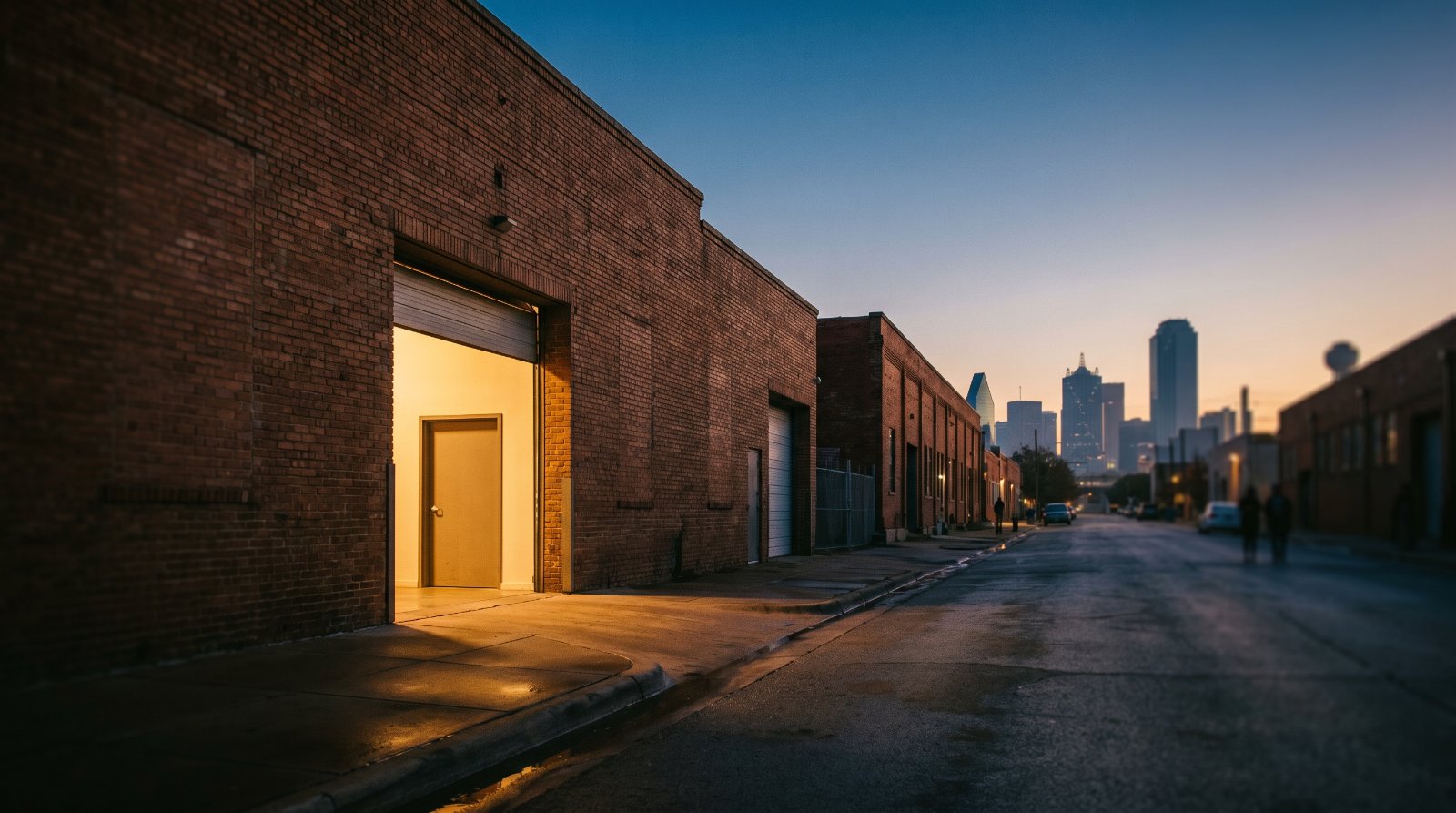
Say “Design District” to most of Dallas and you can watch the interest drain out of the conversation in real time. Furniture showrooms. Rug warehouses. The place your one friend with a decorator went once — on a weekday, with an appointment. It sits in the flats northwest of downtown, pinned between Stemmons and the Trinity levees; and if your entire exposure is the drive down Riverfront toward somebody’s wedding venue, “neighborhood” feels like a generous word for it.
Here’s what that read misses: the Design District is the only part of central Dallas where art gets to be the size it wants to be. Not the size a landlord tolerates — the size it wants. The same warehouse bones that built the wholesale trade make this the one place in the city where a gallery can hang something twelve feet tall without apologizing to anyone. The district has exactly one trick, and it’s a clock — it runs on hours that are almost the perfect inverse of everywhere else in Dallas, and nearly everyone who dismisses it showed up at the wrong one.
The stereotype is true — and it’s load-bearing
The furniture thing didn’t come from nowhere. The district grew up in the mid-1900s as a wholesale trade corridor in the Trinity’s old industrial flats, and for decades its showrooms sold to the trade only; designers in, everyone else squinting through the glass. That started loosening in the 2000s, when showrooms began opening their doors to the public and galleries migrated in for the reason artists migrate anywhere — square footage nobody else was fighting over.
So the showrooms aren’t a phase the neighborhood is growing out of. They’re the load-bearing wall. The design trade keeps the buildings honest — long, deep, high-ceilinged rooms with loading docks and concrete floors — and that turns out to be exactly the container serious art needed. Write the district off for its daytime business and you miss what those same buildings do after dark. The two economies share walls; the second one doesn’t advertise.
Dragon Street is the gallery spine
Dallas galleries cluster here the way venues cluster on Elm Street in Deep Ellum, and Dragon Street is the spine — the densest run of commercial art rooms in the city, with more scattered down the cross streets toward Riverfront. These are working galleries, not gift shops; real shows, rotating monthly, hung in rooms big enough that the work gets air. You can walk in on a Saturday afternoon, spend twenty minutes with paintings priced like cars, and leave without anyone taking your email.
That last part matters more than it sounds. The unspoken rule of gallery-going — the one that keeps the gallery-shy on the sidewalk — is that you’re allowed to just look. Nobody expects you to buy. Nobody is going to make you say something smart. A gallery on a quiet afternoon is one of the few free rooms in Dallas where standing still and thinking counts as participating.
And when several rooms open new shows on the same evening, the street briefly becomes the thing nobody believes Dallas has: a walkable art night. Door to door on foot, wine in plastic cups, strangers comparing notes in front of the same canvas. Watch for those nights; they’re the district’s social season, and they’re the easiest possible way in. An opening is the rare party where showing up alone and knowing nothing isn’t the exception — it’s the default condition.
Anchoring all of it is Dallas Contemporary, the warehouse-scale museum on the district’s Glass Street edge. It’s a museum in the loosest, best sense — a former industrial building where shows get to be enormous, loud, and occasionally bewildering; a full register away from the marble-hall museums across town. If art after dark is your genre generally, the museums-at-night rundown covers the whole city’s version of it. The Contemporary is the Design District doing it at native scale.
The district runs on an inverted clock
Here’s the mechanic that explains every bad first impression: most Dallas neighborhoods fill up on weekend afternoons and thin out by ten. The Design District does the opposite. Its daytime economy runs on weekday trade hours, so a Sunday-at-2pm drive-through delivers exactly what the skeptics report — shuttered showrooms, empty sidewalks, a district apparently in witness protection.
Come back on an opening night, or any evening the rooftop and the dinner rooms are running, and the same streets are alive in a low-key, grown way. No lines, no promoters, no parking blood sport. The people who are there came on purpose, which changes the texture of every room. This is the whole trade the district offers: you give up spontaneity, and in exchange you get intention. Nothing here is trying to catch your eye from a sidewalk, because the sidewalk was never the point.
The practical version: check what’s on before you go, aim for evenings, and treat the district as a destination neighborhood rather than a wandering one. It rewards a plan the way Deep Ellum rewards the lack of one.
The levee edge nobody uses
The district’s western boundary is the Trinity levee system, and threading through the neighborhood is the Trinity Strand Trail — a paved path following the river’s old meander, quietly connecting the warehouse blocks toward the Katy Trail’s orbit. It is, reliably, one of the emptiest good walks in central Dallas. The skyline sits close and fully visible; the light off the levee grass at golden hour is the best free show in the zip code; and most evenings you will pass more herons than people.
It isn’t the Katy Trail and it isn’t trying to be — no ice house waiting at the end, no run-club social layer. But as a pre-dinner walk before a gallery night, or a place to take a visitor who thinks they’ve seen Dallas, the levee edge is the district’s quiet second argument. The neighborhood’s whole aesthetic — big sky, hard geometry, no crowd — concentrates out there.
Where to land when the galleries close
Vibe-level, because the district does one right room per night rather than a crawl:
- The Gallery Rooftop Lounge — the rooftop above the district’s hotel edge, with the skyline at eye level instead of postcard distance. This is the after-opening move; the art conversation continues, now with a view of the city that made it.
- Meddlesome Moth — the district’s long-running gastropub, where the beer list is the point and the room has more character than most bars twice its age. The reliable dinner anchor when the evening needs food underneath it.
- Ascension — the daytime exception to the inverted clock: coffee serious enough to justify the drive, in a room full of people sketching things. If you need the district before dark, start here.
Notice what’s not on the list: a strip. There is no run of bars, no next-door-if-this-is-full option. Each of these is a destination with dead blocks around it — which is either a flaw or a filter, depending on what you want from a night.
When the Design District is the wrong choice
Honesty being the point of these guides — skip it when:
- You want to wander. The blocks are long, the sidewalks are industrial, and striking out means getting back in the car. Browse-and-drift is Bishop Arts territory, full stop.
- It’s Saturday afternoon and you expect open doors. Some showrooms and galleries will be open; plenty won’t. The district’s daytime is a weekday.
- The night wants volume. Dancing, live rooms, a crowd to disappear into — that’s Deep Ellum, which does 1am better than this neighborhood does 11pm.
- You need options stacked next to options. A group that can’t commit will starve here. Take them somewhere with density; save this place for people who’ve already agreed on the plan.
The Design District’s failure mode is specific: you showed up at the wrong hour, saw a warehouse district, and concluded that’s all there was. It isn’t a boring neighborhood; it’s the most schedule-dependent neighborhood in Dallas, which is a different diagnosis entirely. Respect the clock and it delivers. Ignore it and it won’t even wave.
This weekend in the Design District
The verdict: this is Dallas’s best low-frequency neighborhood. Not every week — but when there’s an opening night, a show at the Contemporary, or an evening that wants a rooftop without a scene attached, nothing else in the city offers this particular ratio of art to elbow room. Walk the levee first; hit the galleries at opening-hour; land on one right room after. The district’s warehouse siblings across the city — the ones that trade in sound instead of canvas — get a guide of their own.
And if you’d rather not do the scouting, the Weekend Drop lands every Thursday — a short list of what’s actually worth leaving the house for across Dallas, gallery nights included when they earn it, with who’s going visible before you commit. Tonight-shaped plans live at /tonight, and the wider city hub is at /dallas.
Three, not thirty. And in this neighborhood, honestly — sometimes ONE, chosen well, after six.