
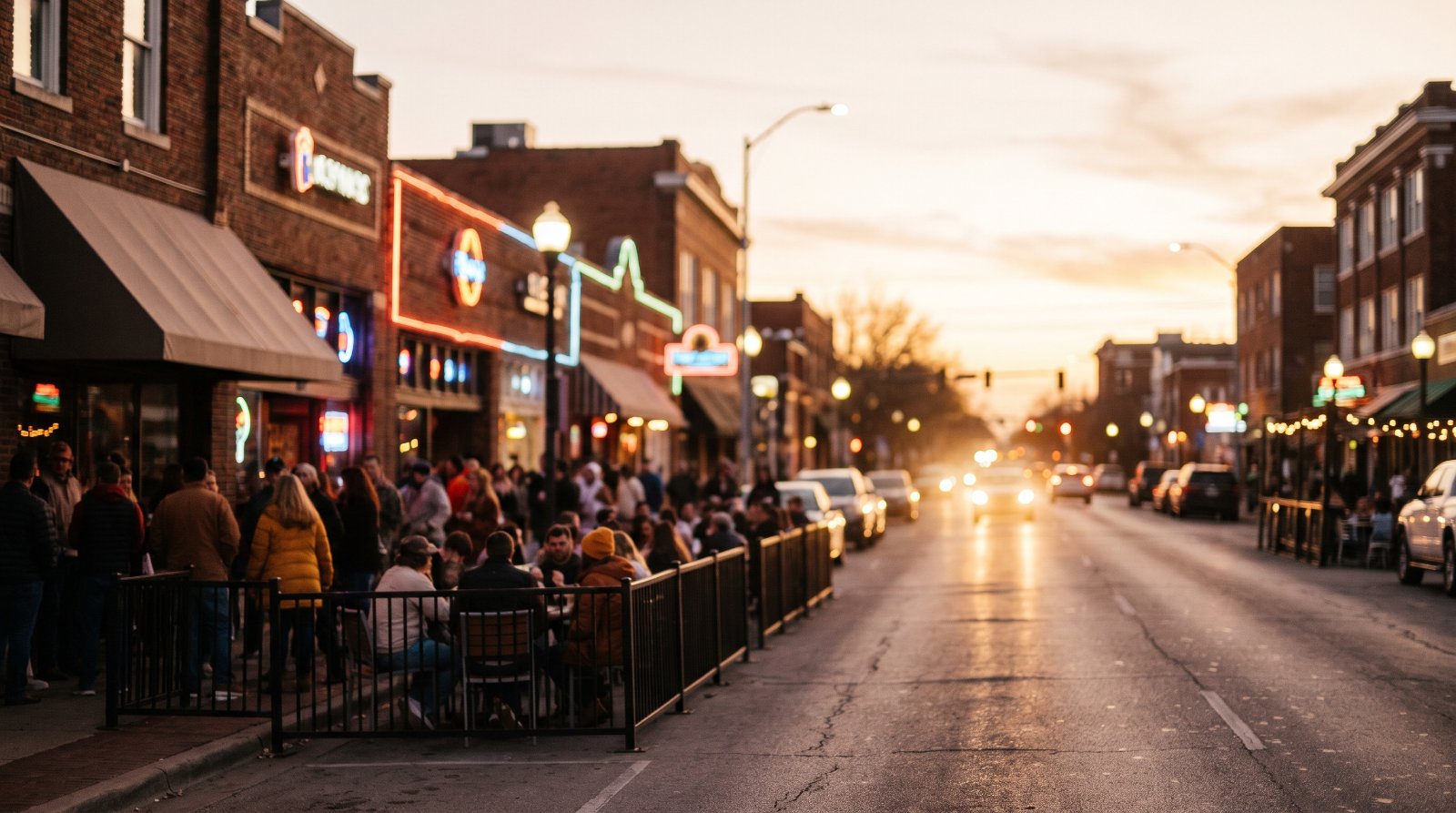
Greenville Avenue runs about three miles from Ross Avenue up past Mockingbird, and it changes character every few blocks: Lowest Greenville is the loud young stretch, Belmont to Mockingbird grows quieter and more grown-up, and the north end handles the errands. Walk it south to north near golden hour; the avenue runs shadeless in stretches.
Most Dallas streets are a way to get somewhere. Greenville Avenue is a way to understand something. Walk it south to north, roughly three miles, Ross Avenue up past Mockingbird, and you move through more versions of this city than any other single stretch of pavement can show you: the strip that parties, the blocks that grew up, the streets that were always grown, the mile that just runs errands. It’s a biography of Dallas written in storefronts, and you can read the whole thing in an afternoon.
One thing this post is not: the neighborhood deep dive. If you want Lower Greenville as a destination, the patios, the anchors, where to actually spend a Friday, that’s the Lower Greenville guide, and it’s the companion piece to this one. That post is about picking a room. This one is about the walk between them: what the avenue does block by block, where its accent changes, and why the changes mean something.
How to read a street on foot
A quick note on method, because the walk rewards it. Streets talk in details; what the parking looks like, how tall the buildings sit, whether the patios face the sidewalk or hide behind it, who’s out at 4pm versus 10pm. Greenville’s whole appeal is that these details shift every few blocks, and the shifts are legible. You’re not walking to get your steps in. You’re walking to watch a city change its mind in real time.
Logistics, briefly: start at the south end in the late afternoon so you hit the northern stretch before dark; wear real shoes; treat the cross streets, Belmont, Richmond, McCommas, Mockingbird, as chapter breaks. In August, this is an after-six undertaking. The avenue runs shadeless in stretches, and Dallas asphalt holds a grudge until sundown.
Chapter one: Lowest Greenville, where the volume lives
The southern blocks, Ross north to Belmont, the stretch the city calls Lowest Greenville, are the part of the avenue with a reputation, and the reputation has been through several editions. What that stretch used to be and what it is now is a story the Lower Greenville guide tells properly; the walking version is simpler. This is the avenue at its youngest and loudest; bars and kitchens packed shoulder to shoulder, patios open to the sidewalk, foot traffic that starts early on weekends and doesn’t so much end as relocate.
Walked through rather than settled into, Lowest Greenville reads like an opening argument. The buildings are low and old, storefront-scale, built for a streetcar city, which is what this was, and every one of them is working hard for your attention. Neon, chalkboards, door staff; the whole apparatus. It’s the only stretch of the walk where the street is unambiguously performing for you, and it’s worth clocking that before the performance stops.
Because it does stop. Cross Belmont and you can feel the avenue drop its shoulders.
Chapter two: Belmont to Mockingbird, where the avenue grows up
North of Belmont the pitch changes. The blocks stretch out, the bars thin into restaurants, and the crowd ages up a few years without anyone announcing it. This is the stretch where the avenue stops selling you a night and starts assuming you have one planned. Reservations instead of walk-ups, wine lists instead of wells, conversations you can hear.
The mile-marker is the Granada Theater, the 1946 movie house whose marquee still runs the avenue’s best light. The Granada belongs to the Lower Greenville story, it’s the anchor of that neighborhood’s case for itself, so this walk will just tip its cap and note what the marquee does to the street: for a block in either direction, everything organizes around it, the way old main streets organized around their theaters. It is the avenue’s one piece of genuine spectacle, and it earns the pause.
Keep north and the residential begins bleeding through. Houses appear between the commercial runs. Trees get serious. The sidewalk traffic shifts from destination-bound to dog-led. You’re approaching the stretch where the avenue’s real tenants live, and the street softens to meet them.
The M Streets detour: one block off, a hundred years back
Somewhere around McCommas, do the thing this walk exists for: turn off the avenue. One block west puts you in the M Streets, formally Greenland Hills, informally the alphabet of streets that gave the neighborhood its name, and into the most concentrated run of Tudor-style houses in Dallas, most of them built in the 1920s. Steep gabled roofs, arched doorways, brick and half-timber; street after street of it.
The detour matters to the walk’s thesis. The avenue is the neighborhood’s commercial spine, but the M Streets are its actual body; the reason the restaurants north of Belmont can afford to be calm. These blocks were built as a streetcar suburb a century ago, and they still carry that scale: porches close to the sidewalk, driveways an afterthought, houses built to be looked at from foot height, at walking speed; which is exactly how you’re looking at them. Fifteen minutes of wandering here recalibrates the whole avenue. When you step back onto Greenville, you’ll read its northern blocks correctly; not as a thinning-out, but as a main street relaxing into the neighborhood that owns it.
Chapter three: Mockingbird and north, where the errands live
Cross Mockingbird and the avenue makes its last change of accent. The storefronts go practical: groceries, hardware, lunch counters, the Old Town shopping center. Central Market sits up here at Lovers Lane, which is as Dallas a landmark as any theater; half the city’s dinner parties begin in its aisles. The buildings spread out, the parking lots widen, and the street stops performing entirely. This is the avenue in work clothes.
Honesty about this stretch: as a walk, the payoff thins. The blocks run longer, the shade runs shorter, and nothing up here needs you the way Lowest Greenville needed you. But it belongs in the biography, because it’s the ending most Dallas streets get; the part where a city’s daily life, not its nightlife, sets the terms. Walk as far as Lovers Lane, call it complete, and you’ve seen the full arc: performance, maturity, home, errand. Three miles, four Dallases.
One day a year, the avenue is a single organism
There’s exactly one day when the walk does itself: the St. Patrick’s parade. Dallas has run it down Greenville Avenue each March for decades, and it’s grown into one of the biggest St. Patrick’s celebrations in this part of the country; the avenue closed to cars, the crowd stretching through the very blocks this post just walked. For one green afternoon, Lowest Greenville’s volume floods the entire street, M Streets porches turn into grandstands, and the avenue’s four personalities dissolve into one.
It’s worth seeing once, mostly because of what it proves; that the street’s separate stretches still think of themselves as one avenue, and will act like it given a parade permit. The other 364 days, the walk is how you get that view.
When the walk is the wrong choice
The honest disqualifiers, because a three-mile walk is not always the assignment:
- You want one great room, not thirty blocks. Skip the survey and use the Lower Greenville guide to pick your destination directly. The walk is for understanding the avenue; the guide is for enjoying it.
- It’s mid-afternoon in August. The avenue offers no mercy between two and six. Golden hour or later; or wait for October, when this becomes one of the best walks in the city.
- You’re in a group. Four people walk at four speeds and want four different stops. This route works best solo or as a two-person operation; solo especially, and if walking your own city alone sounds like a skill worth having, the solo playbook makes that case at length.
- The night needs a crescendo. The walk ends in grocery territory, by design. If you want a finale, run it in reverse, start calm at Lovers Lane, end loud on Lowest Greenville, or hop one neighborhood west afterward, where Knox and Henderson run a two-act night of their own.
This weekend on the avenue
The case, restated: Greenville Avenue is the rare Dallas street that rewards being traveled at three miles an hour, because the point isn’t any single block; it’s the transitions. The strip that performs, the stretch that matured, the Tudor streets that anchor it all, the errand mile that keeps it honest. You can drive it in eight minutes and learn nothing. Walk it once and you’ll never need a neighborhood explained to you the same way again.
And when the walk turns up a block you want to come back to at night, that’s what the shortlists are for. The weekend shortlist comes with a handful of picks across Dallas worth actually leaving the house for, who’s already going, visible before you decide, and the avenue’s rooms show up in it when they’ve earned the slot. Tonight’s version lives at /tonight, and the whole-city hub is at /dallas.
Three, not thirty. The avenue’s been there a hundred years; it’ll hold your pace.