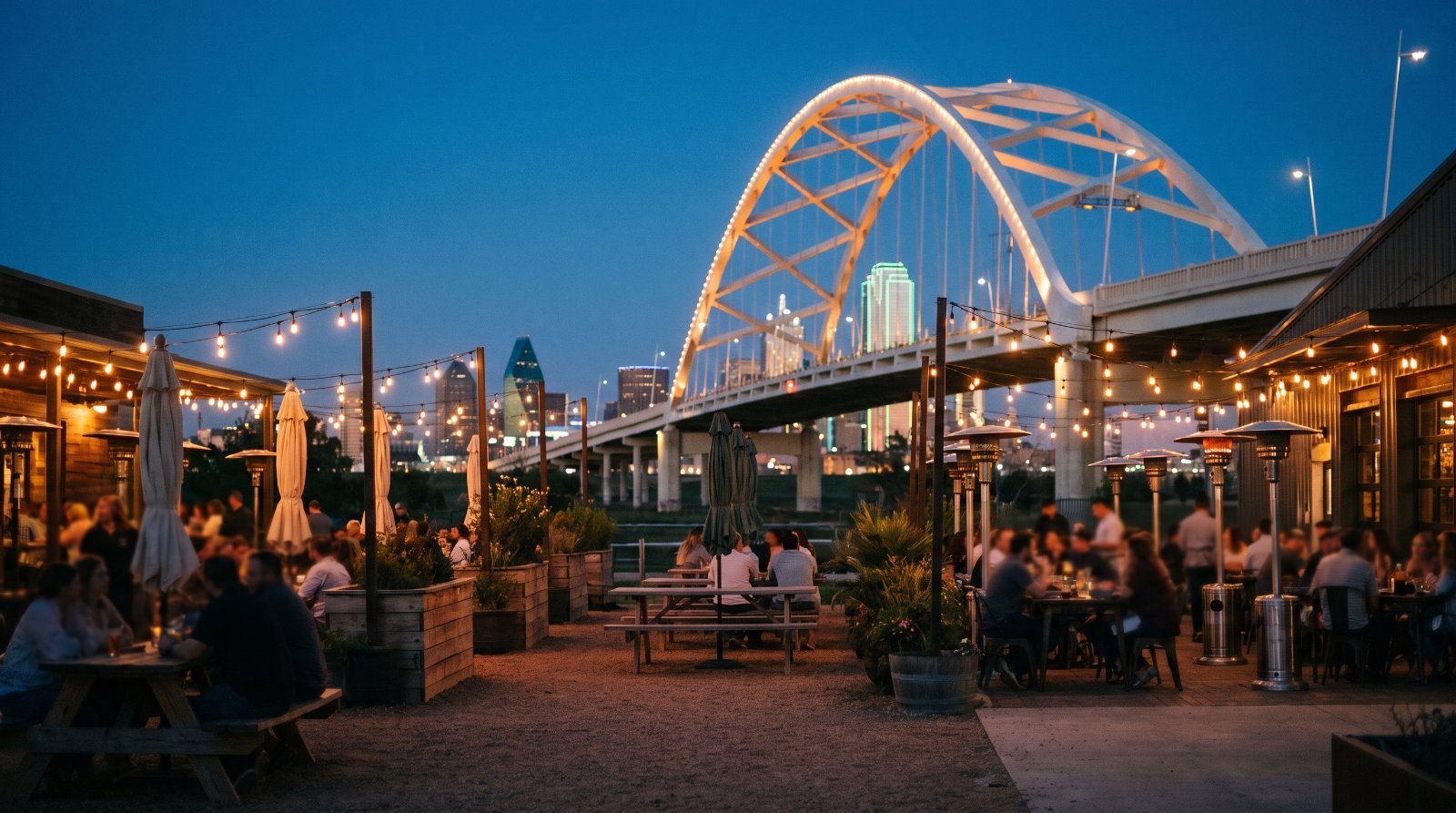
The Margaret Hunt Hill Bridge might be the most photographed object in Dallas. It’s the white arch in every apartment-tower ad, every conference badge, every transplant’s third Instagram post; the city adopted it as a logo almost the moment it opened. And yet the standard Dallas relationship with the bridge is entirely one-sided. You shoot it from the downtown levee. You drive under it on the tollway. And the number of times you’ve crossed it to find out what it was built to connect you to — for most of this city, that count is ZERO.
What’s on the other side is Trinity Groves — a restaurant row planted at the western foot of the bridge, holding the single best view of the Dallas skyline that exists, in a part of the city most people north of the river couldn’t sketch on a map. It’s worth crossing for. It’s also a specific kind of place with specific limits, and pretending otherwise is how people end up disappointed at 9:45pm. Here’s the honest read.
The bridge, and the Dallas habit of not crossing it
Two facts worth actually knowing: the bridge was designed by Santiago Calatrava, the Spanish architect whose signature white arches span rivers across Europe, and it opened in 2012 as the city’s big bet on finally facing the Trinity instead of turning its back to it. That’s the whole history lesson, and it explains the shape of everything at its feet — Trinity Groves exists because the bridge suddenly made West Dallas a five-minute drive from downtown instead of a psychological expedition.
The not-crossing habit is real, though, and it isn’t really about distance; it’s about grooves. Dallas runs on a handful of them — Uptown to Deep Ellum to Lower Greenville — and the west side of the river isn’t on any of them. Crossing the bridge requires a decision in a way that drifting up McKinney doesn’t. Which is exactly why it works as a plan: nobody ends up at Trinity Groves by accident, so the crowd on any given night is entirely people who meant to be there.
A restaurant row built as a lab
Here’s the part of the story most first-timers don’t know: Trinity Groves opened in the early 2010s as a restaurant incubator — a development where new concepts get a first room, a first lease, and a real shot, with the lineup expected to change as ideas graduate or wash out. The rotating cast isn’t churn; it isn’t decline. It’s the design.
That one fact recalibrates how you should use the place. Don’t arrive loyal to a specific restaurant you read about two years ago — it may have moved on, and something unproven and interesting may be in its slot. Arrive loyal to the format instead: a horseshoe of dining rooms and patios you can walk end to end in four minutes, compare menus in the window, and pick by appetite rather than by reservation. It’s the rare Dallas dinner where the decision happens on foot, at the door, with the skyline over your shoulder.
The practical effect is that Trinity Groves is unusually good for groups that can’t agree. The walk-and-compare mechanic absorbs indecision; the loudest opinion in your group text gets exactly one lap to make its case. And because everything shares parking and geography, “let’s just see” is an actual strategy here instead of a stall tactic.
The skyline owes you nothing — except from here
Every rooftop east of the river sells you the skyline from inside it, which means you’re always looking at half of it. The west bank is the only place the city stands up in full: the whole downtown wall, face-on, with the bridge’s arch in the foreground doing its one perfect trick. Sunset happens behind you at Trinity Groves, which means you’re not squinting into it — you’re watching it light the towers up like a slow dimmer switch running in reverse.
The best free version of this is the Ronald Kirk Pedestrian Bridge, the old Continental Avenue crossing one span north, decommissioned from car traffic and handed to people on foot. It runs parallel to the Calatrava arch at exactly the right distance to see it whole, and walking it at dusk is one of the two or three best zero-dollar moves in Dallas — twenty minutes over the river, skyline in front of you the entire way; joggers and quinceañera photo shoots and first dates all sharing the deck. Dinner on one side, walk in the middle, city on the other. If skyline views are the whole assignment, the rooftop rundown covers the from-inside-it version; this is the only chapter where you get to look Dallas in the face.
West Dallas is a place, not a backdrop
One thing worth saying plainly: Trinity Groves is a development at the foot of a bridge. West Dallas is a part of the city — one that was here long before the arch went up, with generations of families, mostly Latino and Black, whose neighborhoods sit within a few blocks of the patios. Singleton Boulevard has been somebody’s main street for a lot longer than it’s been a dinner destination.
You don’t need to do anything ceremonial with that information. Just carry it. It means the right posture on that side of the river is guest, not discoverer — the neighborhood around the restaurant row isn’t an extension of it, and the difference between the two is the difference between visiting a place and consuming it. Eat well, walk the bridge, tip like the view was part of the meal, and skip the urban-safari commentary on the drive out.
How to actually use Trinity Groves
The honest mechanics, because this is where expectations go sideways:
- It’s a drive-to destination, not a wander neighborhood. You arrive, you do the thing, you leave. There is no second act around the corner, no next bar down the block. Plan the night as dinner-plus-bridge-walk and it lands; plan it as “we’ll see where the night takes us” and the night takes you back across the river.
- The patio hours are the good hours. The whole proposition is the view, and the view works at golden hour and after dark. An August afternoon out there is a dare; an 8pm arrival is the move.
- It’s a strong early-date format. Walk-and-compare dinner, then a bridge walk with a skyline doing the talking during any lull. Built-in ending, built-in extension — the Kirk bridge is right there if it’s going well.
- Take out-of-towners here first. Not because it’s the most Dallas place — because it’s where Dallas is most visible. The city literally lines up for the photo.
When Trinity Groves is the wrong choice
Skip the crossing when:
- You want a night with chapters. Dinner here ends and the neighborhood ends with it. If the plan needs a bar after the bar, stay east — Deep Ellum exists for exactly that appetite.
- You want to browse. No bookstores, no record bins, no storefront drift. That’s a Bishop Arts afternoon — one neighborhood south, a world apart in texture.
- Live anything is the point. The stage-shaped part of the night lives elsewhere; this is a dinner-and-view format, and it’s honest about it.
- You’ve been three times this month. The view doesn’t change. That’s its power on a first visit and its ceiling on a fifth. Trinity Groves is a rotation player, not a home base.
The failure mode here is arriving with Deep Ellum expectations: you’ll have a great dinner, take the best photo of your year, and be confused about what to do at 10pm. The answer is nothing. You go home. That’s not the neighborhood failing — that’s the format working exactly as designed.
This weekend in Trinity Groves
The verdict: cross the bridge — deliberately, occasionally, at the right hour. Trinity Groves does one night shape and does it close to perfectly: a walk-up dinner decision, the city’s best view for free, and a pedestrian bridge that turns the drive home into the last scene of the evening instead of an errand. Every city has a place it takes its own picture from. Dallas’s happens to serve dinner.
If you’d rather have the week’s short list handed to you, the Weekend Drop lands every Thursday — a few things across Dallas actually worth the drive, west side included when it earns the slot, with who’s going visible before you commit. Tonight’s version lives at /tonight, and the full city hub is at /dallas.
Three, not thirty. And once in a while, one of the three is on the other side of the river — exactly where the photo gets taken from.