
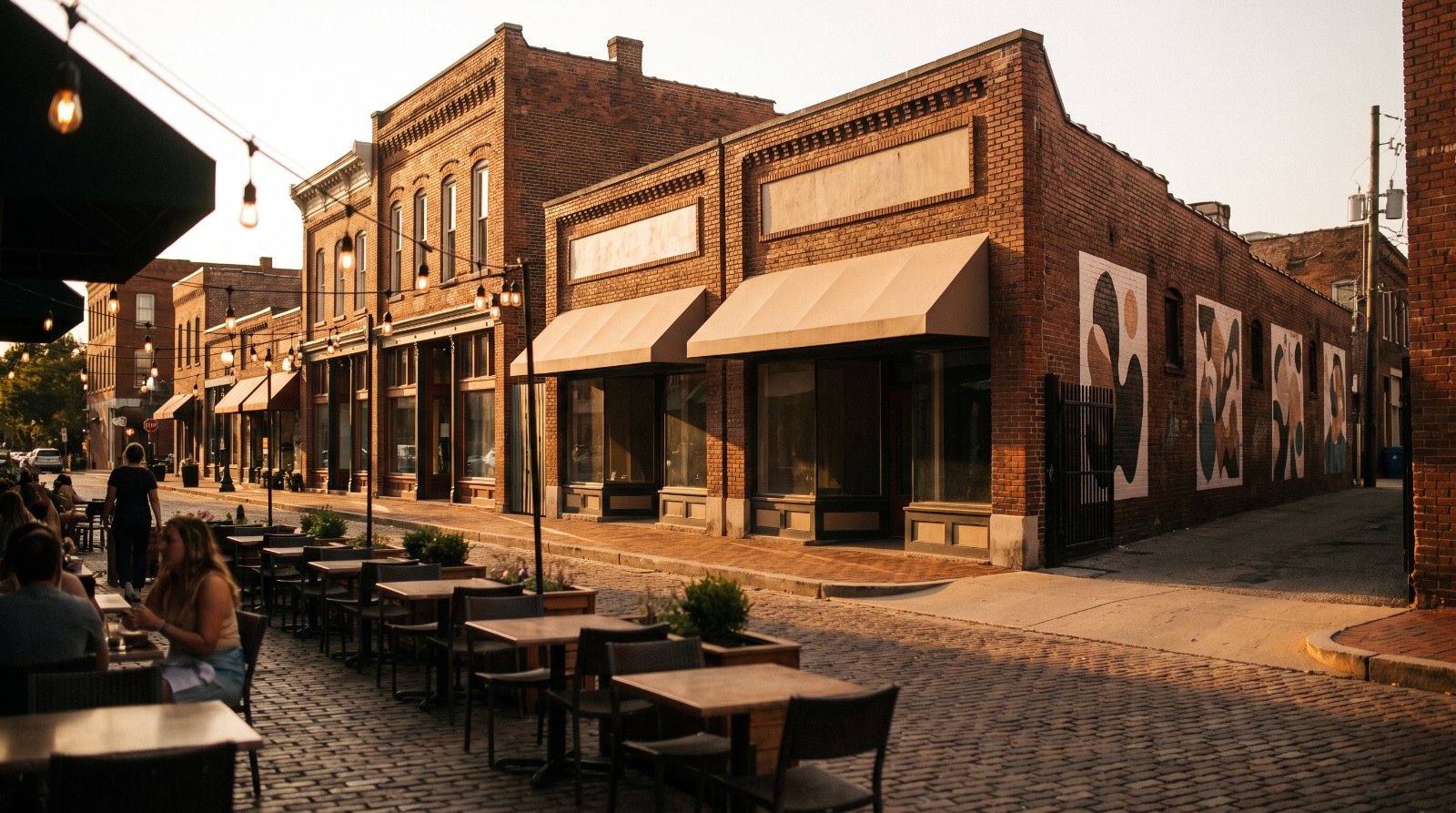
Oak Cliff is far bigger than the six blocks of Bishop Arts: it holds the Texas Theatre, the Kessler listening room, and Jefferson Boulevard, one of the most alive streets in Dallas. Treat it as a set of destinations rather than a strip to wander; pick the show or the room first and build the evening around it.
Ask someone in Uptown about Oak Cliff and you’ll get one of two answers; both wrong. The first is Bishop Arts plus rumor; cute blocks, good tacos, a vague gesture at everything past them. The second is a stack of secondhand opinions about “south of the river” from people whose cars have never actually crossed it. Either way, the north-of-the-Trinity read compresses the biggest, oldest, most rooted part of Dallas into a postcard and a shrug.
Here’s the correction this guide is built on: Oak Cliff isn’t a district you visit; it’s a third of the city. And it was its own city until Dallas annexed it in 1903, which the place has arguably never fully conceded. People are from Oak Cliff in a way people are not from Uptown. Generations deep; schools and parishes and family businesses deep. That changes what a guide should be. This isn’t a treasure map. It’s directions. To a handful of rooms and streets that are open to anyone who shows up right: as a customer and a guest, not a scout for content.
One scope note: the Bishop Arts core has its own guide, and this piece deliberately doesn’t re-walk it. This is about North Oak Cliff beyond those six blocks; which is where most of the good stuff was all along.
Start with the scale, because it rewires the visit
North of the river, “neighborhood” means a walkable pocket you park once for. Oak Cliff doesn’t work that way. It’s a sprawl of actual neighborhoods, hills, oaks, 1920s bungalows, mid-century blocks, stitched together by a few long commercial streets: Davis running west, Jefferson running parallel below it, Tyler and Polk cutting across. The nodes are minutes apart by car, not steps.
So the visit has a different shape here. You don’t wander Oak Cliff; you go to a specific place in it, do that thing well, and maybe add a second stop. That’s not a flaw to route around; it’s the structure of a part of the city that grew up as its own town, with its own main streets, rather than as an entertainment district. Adjust the expectation and the whole area opens up.
The Texas Theatre does more living than history
The Texas Theatre on Jefferson is the landmark everyone half-knows and almost nobody has actually been inside. Two sentences of history, because they’re unavoidable: it opened in 1931 as one of the grand movie palaces of its era, and in November 1963 it became the place where Lee Harvey Oswald was arrested, which fixed it permanently in the national memory. The building carries that weight without performing it. There’s no exhibit; there’s no morbid theater. There’s a movie theater.
And what a strange, great one; an independent house that programs rep screenings, new oddities, and the kind of one-night film events that give a city its inner life; with a real bar in the lobby, so the movie comes with a before and an after built in. Seeing a film there on a weeknight is one of the most quietly excellent things to do in Oak Cliff; a multiplex-simple plan that feels like membership in something. The marquee alone, that neon tower over Jefferson, is worth the drive at dusk.
The Kessler is the listening room the city measures against
A few minutes away on Davis Street sits the Kessler Theater, a restored theater from the same movie-house era that now runs as the listening room other Dallas venues get compared to. Small enough that every seat is a good one; booked with taste across genres; run like the music is the point, because it is. Deep Ellum is where Dallas goes to stand in a crowd. The Kessler is where it goes to actually hear something.
A Kessler show is also the perfect armature for a first real Oak Cliff evening: dinner somewhere on Davis, the show, and the drive home along streets that look like no other part of Dallas. Where the room fits in the city’s larger live-music ecosystem, volume rooms, discovery rooms, sit-down rooms, is mapped in the live music guide; the short version is that when the Kessler’s calendar matches your taste even once a month, it quietly becomes your favorite venue in the city.
Jefferson Boulevard is the most alive street in Dallas
Jefferson Boulevard doesn’t appear on many weekend-guide lists, which says more about the lists than the street. This is one of the longest-running working main streets in the city; quinceañera dress shops with windows like parade floats, panaderías, botánicas, jewelers, taquerias that have outlived every restaurant trend north of the river. On a Saturday it’s full of families doing actual life: shopping for a daughter’s fifteenth birthday, getting boots resoled, eating lunch in rooms where the menu hasn’t needed to change.
The way in is simple: be a customer. Come hungry, eat well, buy the pan dulce, browse where browsing is welcome. What Jefferson doesn’t need is an audience; the street isn’t a set, and treating it like a photo walk is the fastest way to be the wrong kind of visitor. Spend money where people have been earning it for decades and you’re participating in the street’s actual economy; which is the entire difference between visiting a place and gawking at one.
The Texas Theatre anchors one end of this logic perfectly: movie first, then lunch on Jefferson, and you’ve had a more textured Dallas afternoon than any patio crawl delivers.
Lake Cliff, Tyler Station, and the found hours
Two more coordinates for the map, both low-key on purpose:
- Lake Cliff Park. A park from the neighborhood’s earliest era wrapped around a small lake, with the downtown skyline stacked up across the river from its northern edge. Morning walks, big pecan shade, one of the best sunrise-on-the-skyline views in Dallas and effectively zero competition for it. Free, obviously; which still matters in this city.
- Tyler Station. An old mill building turned into a warren of makers, small studios, and workspaces, with a neighborhood brewery pouring under the same roof. It’s the vibe-level answer to “where does creative Oak Cliff actually work all day,” and worth a look when something public is on there.
Neither is a destination you build a whole night on. Both are the connective tissue that turns a single-stop trip into an afternoon that feels like it happened somewhere real.
When Oak Cliff is the wrong choice
Honesty, both directions:
- You want a walkable strip that runs itself. That’s the Bishop Arts core; its guide is here. Or Lower Greenville. Broader Oak Cliff asks you to have a destination and a car.
- You want a nightlife district. Oak Cliff’s night runs on specific rooms, a show, a screening, a long dinner, not on volume or a crawl. If the plan is loud-until-late, that’s Deep Ellum’s department.
- You’re hoping to “discover” something. Wrong verb; wrong posture. Everything worth going to here was somebody’s regular spot before you heard of it. Go be a good guest at an established thing; the neighborhood has no vacancies for pioneers.
- You’ve got forty-five minutes and no plan. The distances will eat the whole window. Oak Cliff rewards the committed afternoon and the planned evening, not the drive-by.
The failure mode isn’t having a bad time; it’s having a thin one: doing a lap of the obvious blocks and concluding you’ve seen it. The fix is one specific commitment. A marquee, a show, a lunch counter. Depth here is a choice you make before you cross the bridge.
This weekend in Oak Cliff
The verdict: Oak Cliff belongs in your rotation as the place you go on purpose; the Texas Theatre weeknight, the Kessler night when the calendar cooperates, the Jefferson Saturday lunch, the Lake Cliff morning you’ll want to repeat. It will never be the neighborhood you stumble into; and that’s precisely its value. Everything you do there, you meant.
The weekend shortlist is a short list of what’s worth leaving the house for across Dallas, and when a Kessler show or a Texas Theatre one-nighter makes the cut, you’ll see who’s going before you commit. Tonight-shaped plans live at /tonight; the full city hub is at /dallas.
Three, not thirty. And when one of the three is south of the river, take it; the city’s oldest side keeps its best evenings for people who cross on purpose.