
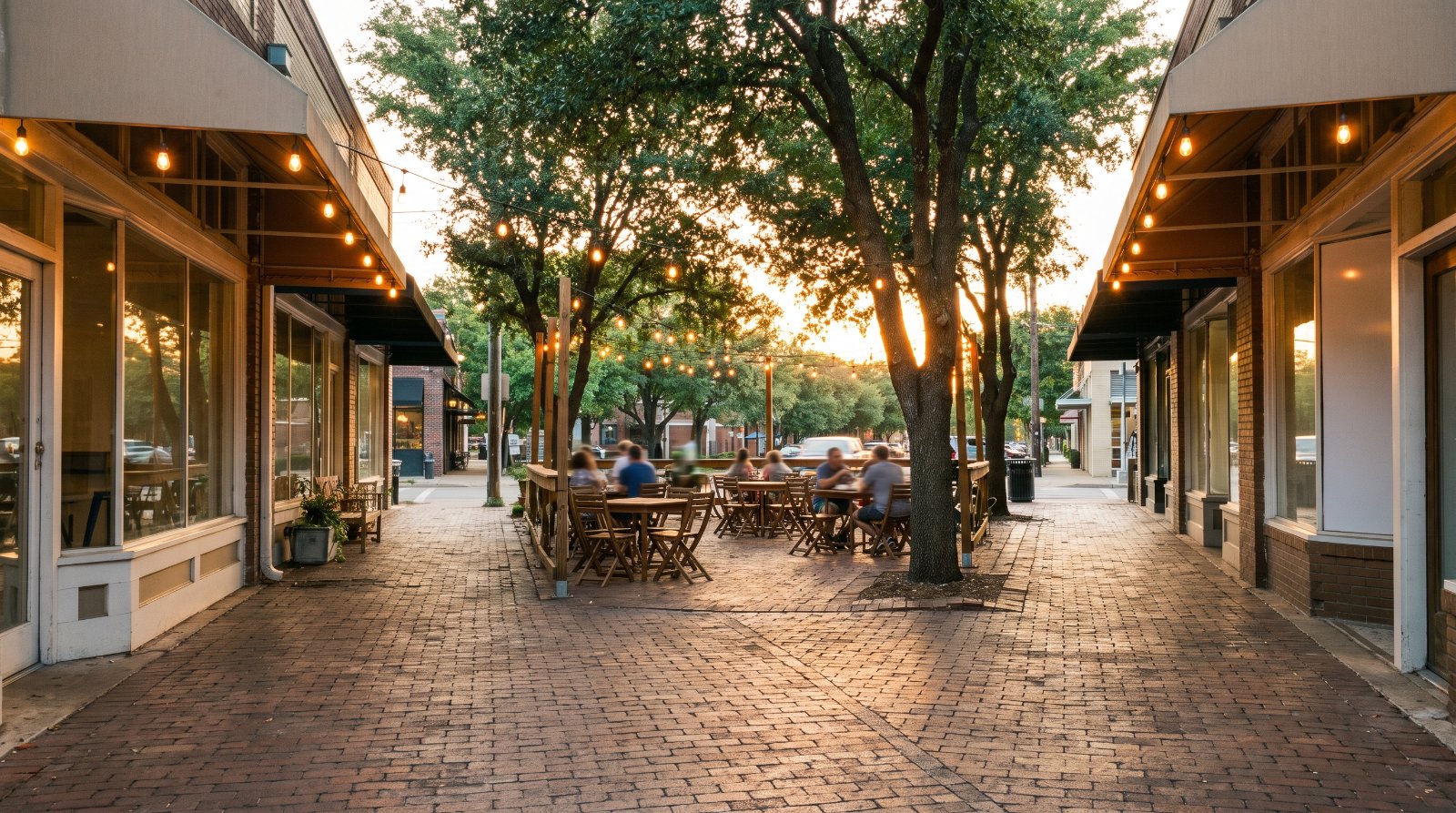
Bishop Arts West is what starts when the retail blocks end: head west on Davis Street past the mural block and you reach the Kessler Theater, Spinster Records, and the porch streets of Winnetka Heights one block south. Go west first and finish in the core; this corridor is for using the street, not photographing it.
Watch where people stand when they photograph Bishop Arts and you can draw the district’s perceived border in chalk: the mural, the pie, the two blocks of Bishop Avenue everyone means when they say the name. Then watch which way they leave. Almost nobody walks west; and west is where the neighborhood keeps going; down the West Davis corridor, into Winnetka Heights, through blocks that hold more of Oak Cliff’s actual life than the photographed core ever could.
To be honest about what this post is: the core has its own guide; the Bishop Arts District guide covers the bookstore-bar circuit, the jazz room, the pie that earns its reputation, and when to visit so the crowds don’t ruin it. Read that one first if the district is new to you. This post starts where that one’s map fades: the moment you cross out of the retail blocks heading west on Davis Street, and the neighborhood stops posing and gets on with its week.
Where the core ends and the corridor begins
The transition is abrupt enough to feel on foot. One minute you’re in storefront-retail Bishop Arts, little shops, patios, weekend foot traffic, and a few minutes west on Davis the sidewalk empties, the buildings space out, and the businesses stop being for visitors. A tire shop. A panadería. A bar with regulars instead of reviews. The street’s job changes from being seen to being used; and if you keep walking, yours does too.
This is the corridor’s whole appeal, and it requires an honest expectation-setting: Bishop Arts West is not a denser, secret version of the core. It’s the opposite; a lower, slower, more residential stretch where the good stuff sits farther apart and rewards intent rather than browsing. You don’t wander it the way you wander Bishop Avenue. You go for one specific reason, and the neighborhood fills in around the errand.
It helps to know why the street reads this way. Davis was built as a streetcar commercial strip, the same era and logic that produced the core; a spine of small storefronts serving the houses a block on either side. When the core got rediscovered, its stretch of that spine turned outward, toward visitors. The western stretch never did. Same bones; different tenant list; and the difference is the entire point. What you’re walking through on West Davis is what the whole district looked like before it had an audience.
West Davis, block by block
The corridor’s anchor, and the best single reason to point yourself west, is the Kessler Theater, the 1940s movie house on Davis brought back to life as one of the finest listening rooms in Dallas. It’s an intimate, seated-and-standing venue where touring songwriters and jazz players work rooms small enough to hear a guitar breathe, and its restored marquee is West Davis’s lighthouse: on show nights the glow pulls people down blocks that are otherwise porch-lit and quiet. If the core’s Revelers Hall is jazz at conversation distance, the Kessler is the corridor’s grown-up sibling; same intimacy, bigger stage, deeper bench.
Around it, the corridor’s institutions run older and humbler. Norma’s Cafe has been slinging diner breakfasts on Davis since the 1950s; a room where the coffee refills are automatic and half the tables have been sitting in the same booths for decades. El Si Hay works its lot as a walk-up taqueria of the kind that needs no interior at all; order at the window, eat standing up, understand immediately why the neighborhood never needed the food scene to arrive when it was already here. Spinster Records holds down the vinyl end of the corridor, a record shop with real taste and the browsing pace the core’s shops promise but can’t deliver on a busy Saturday.
That’s the register of West Davis: not an itinerary, a rotation. Show at the Kessler, tacos at the window, breakfast the next morning, a record on the way home. Institutions, not attractions.
Winnetka Heights: the porch district
One block south of Davis, the corridor’s residential half begins, and it’s worth the turn. Winnetka Heights is one of Dallas’s designated historic districts; street after street of early-1900s houses, craftsman porches and prairie-style rooflines, built in the streetcar era and still carrying its proportions: houses close to the sidewalk, porches meant to be sat on, live oaks that have had a century to close ranks over the street.
Walk it at dusk and the neighborhood explains itself. Porch lights come on. Dogs announce you, block by block, like a relay. The houses aren’t museum pieces, they’re lived in, in every state from lovingly restored to honestly weathered, and that mix is exactly the point. This is what the district’s charm is made of upstream of every storefront: a real streetcar-era neighborhood, at porch scale, that happened to keep its bones. The core’s photographers rarely make it down here; that suits the porches fine.
Treat it accordingly. These are homes, not a set; walk, nod, keep your camera on the architecture rather than through anyone’s front window, and leave the sidewalk chalk drawings where they are.
The loop itself needs no map: pick any street south of Davis, walk until the canopy breaks, turn, repeat. Twenty minutes covers a satisfying circuit; forty covers the district’s best of it. The houses do the pacing for you; every block has one porch, one paint job, one absurdly confident turret that stops you mid-stride. It’s the cheapest great walk in Dallas, and unlike the Katy Trail you will not be sharing it with the entire fitness economy.
How to use it: the west-first evening
The pairing with the core is the move, and direction matters. Run it west-first: early tacos at the window while the light is good, a slow Winnetka Heights loop as the porches light up, then the Kessler’s marquee; and if the night still has legs afterward, drift east into the core, where the bookstore-bar and the jazz room hold the late shift. Done this way, the core stops feeling like a set piece, because you’re arriving from the neighborhood instead of from a parking app. Context first, postcard second.
The morning version works too, and it’s the cheaper date: Norma’s booth, record browsing at Spinster, porch loop before the heat gets serious. If slow mornings in third places are becoming your genre, the coffee shops guide runs the citywide version of that playbook. And for the wider territory this corridor belongs to, the theaters, Jefferson Boulevard, everything north Oak Cliff holds beyond the district, the Oak Cliff guide is the map one zoom level out.
When Bishop Arts West is the wrong choice
The honest disqualifiers:
- You want browsing density. The corridor’s stops sit blocks apart with residential in between. If you want twenty doors in five minutes, that’s the core’s job; go read its guide, and go on a Wednesday.
- You want a late night. Aside from show nights at the Kessler, West Davis winds down early. Midnight ambitions belong across the river.
- You’re arriving without a reason. This stretch rewards a booked show, a taco craving, a walking mood. Show up with none of the three and you’ll conclude there’s nothing here; which is wrong, but will feel true.
- It’s 3pm in August. The porch loop is a golden-hour-or-later activity. The canopy helps; it doesn’t perform miracles.
The failure mode, for the record: you did the whole corridor in ninety minutes and went home early. Recoverable; the core is a ten-minute walk east and holds the nightcap.
This weekend west of Bishop
The case, compressed: Bishop Arts is real, and the proof was never on the mural block; it’s in the neighborhood that block belongs to. Go west once. Eat standing up at a taco window, hear a songwriter in a seventy-year-old theater, walk a street where every house predates your grandparents, and then decide which Bishop Arts you actually like better. There’s a decent chance it’s this one; there’s an even better chance you stop needing them to compete.
For the short list version of the week, the weekend shortlist is a few picks across Dallas actually worth leaving the house for, who’s already going visible before you commit, and the Kessler’s calendar shows up in it whenever it earns the slot. Tonight’s options live at /tonight, and the citywide hub is at /dallas.
Three, not thirty. The porches aren’t going anywhere.