
Tag: bishop arts

  • The Best 3 Hours in Dallas: Five Circuits, Two Stops Each

    The Best 3 Hours in Dallas: Five Circuits, Two Stops Each

    Every bad night out you’ve ever had was too long, and most of them were too wide. Five hours, four stops, three parking situations, two neighborhoods; and somewhere around hour four the evening stopped being fun and became logistics with drinks. Meanwhile the nights you actually retell are almost embarrassingly small: dinner and a show. A walk and a bar. Golden hour and one long table. Three hours, two stops, done before anyone got tired of anyone.

    That’s not an accident, and it’s not lowered expectations. It’s the correct specification. A great night is three hours and two stops; three stops at the absolute ceiling, and only when they’re a short walk apart. This post makes the case once, then hands you five ready-to-run circuits across the metroplex. Consider it the only Dallas itinerary template you need to keep: not a list of places; a shape you can pour any evening into.

    The case for the short night

    Three hours is the honest length of human enthusiasm. Hour one is arrival and appetite; hour two is the peak; hour three is the warm glide down. Everything after that is chasing hour two, buying rounds nobody needs, adding a stop to postpone the ending, and it works about never. The best hosts have always known this: end things slightly before anyone wants them to end, and the night gets remembered at its peak instead of its residue.

    Two stops is the honest width, and the reason is contrast. One stop is a nice evening but has no story arc; nothing happened next. Two stops gives the night a hinge: the walk between them, the change of light and volume, the tiny joint decision that this evening is going somewhere. Four stops gives you four opening acts and no show.

    And the walking is not decoration; in this city it’s the entire trick. Dallas nights die in cars. Every drive between stops is a fifteen-to-twenty-minute momentum tax (park, pay, re-park, re-orient), and two of those taxes will eat an hour of your three. So the rule that makes everything else work: drive to the night once, then never again until home. Pick a neighborhood, plant the car, and let your feet run the itinerary. Which means the real unit of a Dallas night out isn’t the venue; it’s the circuit. A tight loop of two or three stops in one walkable pocket. Here are five, field-tested, one per mood.

    Circuit one: Bishop Arts; the bookstore, the counter, the horn section

    The most complete three hours in Dallas, and the proof of the whole theory, because the entire circuit fits inside a few blocks of Oak Cliff. Start at the bookstore-bar, The Wild Detectives, a house full of books that pours wine and lets you hold both at once, right at opening-of-evening, when the light through the front porch is doing its best work. Browse for forty-five minutes; buying is optional, the ritual isn’t. Stop two is dinner at a counter; the neighborhood keeps several small rooms where the bar seats face the kitchen, and a counter seat turns dinner into theater without adding a dollar. Stop three, the ceiling stop, is the jazz room: Revelers Hall, a shoebox with a live band most nights, close enough to hear the brass from the sidewalk before you commit. Total walking: maybe six hundred meters all evening. The Bishop Arts guide has the full lay of the land, and the west side’s second act is there when you outgrow the postcard blocks.

    When it works: any evening; but it’s built for a first date or an out-of-town guest, because the circuit does the impressing so nobody has to.

    Circuit two: Deep Ellum; the patio, the show, the slice

    Deep Ellum is where the two-stop rule earns its keep, because the neighborhood is engineered to turn one night into five stops and then bill you for all of them. Resist. Start on a patio or in a taproom on the quieter end of the grid around 7; one drink, one hour, let the neighborhood’s volume come up around you. Stop two is the anchor and the reason you came: a show. Any room, any bill; the neighborhood stacks stages within a few blocks of each other, so pick by volume, not by name recognition. That’s the circuit. The optional third stop isn’t another bar; it’s the late slice or the taco window on the walk back to the car, which is less a stop than a victory lap. The Deep Ellum guide reads Main, Elm, and Commerce for you; what’s actually on the stages tonight lives at /tonight.

    When it works: Thursday through Saturday, when you want the night loud and the week overwritten.

    Circuit three: Uptown; golden hour on the trail, then one long dinner

    The inverted circuit: this one starts with the free stop and spends the whole budget on stop two. Get on the Katy Trail an hour before sunset, September finally makes this pleasant again, and walk it while the whole corridor goes gold and the day’s residue burns off. That’s stop one: zero dollars, and the best mood-setter in the city. Stop two is dinner just off the trail, and Uptown’s density means you’re never more than a few blocks from a patio table or a bar seat when the light runs out. No third stop. The trail already was the show; dinner is the encore, and a night that’s one walk and one table has a calm no amount of itinerary can buy. The Uptown guide covers where the trail spits you out.

    When it works: the golden-hour window, obviously; and it’s the strongest low-key date circuit in Dallas precisely because it doesn’t try hard.

    Circuit four: Design District; the galleries, then the cocktail room

    The city’s best-kept weeknight circuit. The Design District’s warehouse galleries cluster tightly enough that on an opening night you can walk three shows in ninety minutes; free, air-conditioned, and full of things to talk about, which is the quality that makes this the great conversation circuit. (On non-opening nights, one gallery with evening hours plus a slow lap of the showroom blocks does the same work at lower volume.) Stop two is a cocktail room or dinner nearby, where the argument about the art you just saw becomes the entertainment. The circuit’s secret is sequencing: culture first, drinks second. Run it backwards and the galleries become homework; run it forwards and the bar has a built-in agenda. The Design District guide maps which blocks hide the rooms; opening nights are dated, so check the weekend shortlist for what’s on.

    When it works: weeknights and first Saturdays; and it’s the circuit for the friend who claims to be over going out.

    Circuit five: Fort Worth. Magnolia Avenue, start to finish

    Yes, Fort Worth. Thirty-five miles is a real objection at 6pm on a Tuesday and a fake one on a Saturday, and Magnolia Avenue is the single best street-as-circuit in the metroplex: a walkable near-mile of restaurants, bars, coffee, and rooms with live acts, where the entire evening runs on one parking decision. Start with a slow browse of the avenue while it’s light; record shop, coffee, whatever the street offers you. Stop two is dinner anywhere on the strip; the density does the choosing. Stop three, if the night has a third act in it, is one of the avenue’s live rooms or backyard bars. The point of this circuit isn’t any single stop; it’s the street itself, and the mildly vacation-shaped feeling of running a whole evening somewhere that isn’t your default city. The Fort Worth guide makes the full case for the other half of the metroplex.

    When it works: Saturdays; and any night you catch yourself saying Dallas feels small; it isn’t, you’ve just been running the same circuit on repeat.

    How to run a circuit

    Five shapes, one operating manual.

    • Three hours means start by 7. A circuit that starts at 9 isn’t a short night, it’s a late one, and it borrows the whole thing from tomorrow morning.
    • One car decision per night. Park once, inside the circuit. If a stop requires re-parking, it’s not part of tonight’s circuit; it’s the seed of a different night.
    • Two stops is the spec; three is the ceiling. The third stop must be a short walk and must be smaller than stop two, never bigger. Nights should taper, not re-peak.
    • End on time, on purpose. Leaving at the peak is a skill. The circuit’s whole advantage is that it ends before it decays; protect that, even from yourself.
    • Repeat before you branch. Run a circuit twice and the rooms start recognizing you, which upgrades every future lap. Novelty is overrated; the second visit is where a city starts feeling like yours.

    A good shortlist is a circuit with names on it

    To be honest, this whole essay is the philosophy behind a product; so let’s just say it. The weekend shortlist is that product; and a good shortlist is really a pre-built circuit: a couple of picks that sit near each other in space and time, the free one flagged, and who’s going attached to each. That last part is the one thing no itinerary template can generate on its own; and it’s usually the thing that actually decides a night.

    So: five circuits, one shape, three hours. Tonight’s version is at /tonight, the weekend’s at /weekend, and the rest of the map lives at /dallas. Pick a pocket, park once, and give the night a hinge. The best three hours in Dallas are whichever three you actually go get.

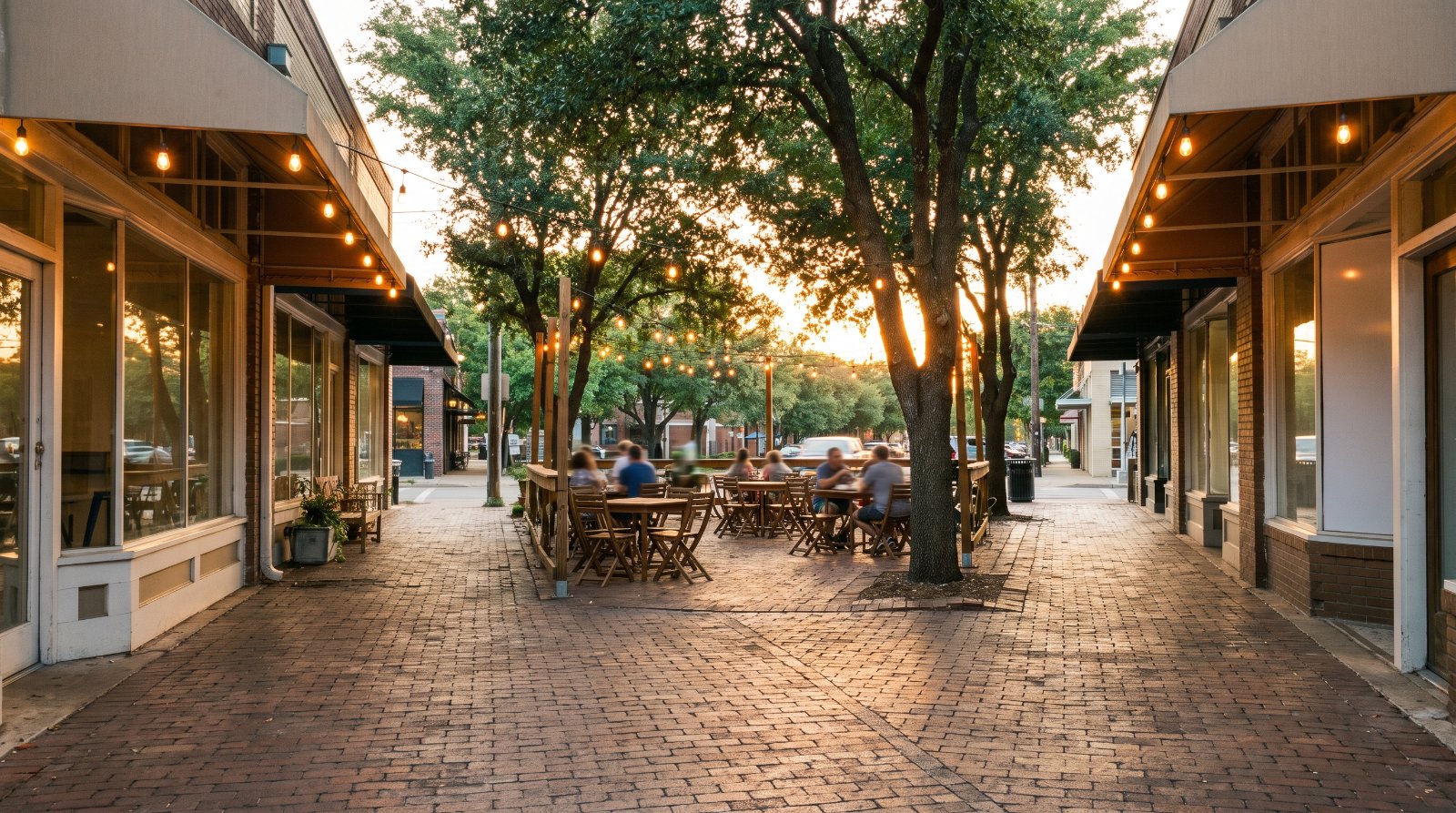
  • The Bookstore Is the Last Store in Dallas Where You’re Allowed to Be Slow

    The Bookstore Is the Last Store in Dallas Where You’re Allowed to Be Slow

    Every commercial room in Dallas is optimized to move you along. The coffee line wants you decided before you reach the register. The restaurant wants the table back in ninety minutes. Even the places built for browsing have gone efficient; you’re tracked, funneled, and politely hurried from the moment the door chimes. Then there’s the bookstore, where you can stand in one aisle for forty minutes, read a third of something you never buy, and nobody so much as glances at you. It is the last retail format in the city where slowness isn’t shrinkage. Slowness is the point.

    That makes the good bookstores in Dallas worth more than their inventory. In a city chronically short on rooms where you can exist without a schedule, the bookstore is one of the few left standing; and Dallas, quietly, has a strong independent layer that most people who “keep meaning to read more” have never actually walked into. This is the map; plus the case for the bookstore event as the easiest night out this city offers.

    Slow is the product

    Consider what your attention goes through in a normal Dallas day: a commute engineered around it, a job that meters it, a phone that auctions it off in fifteen-second lots. Every environment you pass through is bidding. The bookstore is the one commercial room that isn’t. Nothing in it refreshes. Nothing counts down. The spines don’t autoplay.

    Browsing, real browsing, no list, no destination, is one of the last unscheduled activities adults get, and it does something the feed can’t: it lets you find the thing you weren’t looking for. An algorithm shows you more of what you already liked. A shelf shows you what the person who built it liked, which is how you end up leaving with a Hungarian novel when you came in for a birthday card. That serendipity is the product. The book is just the receipt.

    The test: does the store have a point of view?

    Not every room with books in it earns the slow treatment, so run the test from the front table. A real bookstore is an argument about what’s worth reading; a shelf of bestsellers is a vending machine.

    The evidence is always in the same two places. First, the staff-picks table: if the handwritten cards are specific, opinionated, and slightly unhinged, humans who read live here. If the front table is just this month’s national bestseller list restacked, the room has no author. Second, the events wall: a store that hosts readings, signings, and book clubs is telling you it thinks of itself as a room for people, not just inventory. Third, subtler: is there anywhere to sit? A chair in a bookstore is a policy statement. It says stay.

    The independent layer, by neighborhood

    Four rooms, four different jobs. Vibe-level only; go slow and find the rest out yourself.

    Bishop Arts. The Wild Detectives

    The format proof. A converted house in Bishop Arts where the bookstore and the bar are the same room, and the backyard hosts everything from readings to bands. The Wild Detectives settled an argument most cities are still having: that a bookstore can be a genuine social venue; a place you go out to; without the books becoming wallpaper. Order a drink, pick a shelf, take both to the yard. It’s also the single best argument for the neighborhood around it; the Bishop Arts guide covers the rest of the block-by-block case.

    North Dallas. Interabang Books

    The full-service independent: bright, deeply stocked, staffed by people who read like it’s a competitive sport. This is where the staff-picks test pays off most visibly; ask one open-ended question and you’ll leave with three titles and a small reading list for later. If Wild Detectives is the bookstore as night out, Interabang is the bookstore as institution; the city needs both.

    Deep Ellum. Deep Vellum Books

    The most literary room in Dallas, full stop. Deep Vellum is a publisher, a nationally serious one, particularly for work in translation, with a storefront, which makes browsing here feel like reading someone’s actual convictions. The shelves skew international, independent, and unbothered by what’s trending. Come here when you want the Hungarian novel on purpose.

    Northwest Highway; the Half Price Books mothership

    The used-book cathedral. The flagship is a warehouse of second chances, out-of-print oddities, five-dollar hardcovers, entire genres you forgot existed, and it rewards a completely different browsing mode: no point of view, all volume, pure excavation. It’s the right room for a rainy Saturday and a wrong-turn discovery, and the only one on this list where two hours can pass without your noticing the first one.

    The reading is the introvert’s event format

    Here’s the part that makes bookstores an events story and not just a shopping one: most of these rooms host things; author readings, signings, book clubs, the occasional backyard show. And the bookstore event might be the most structurally forgiving night out in Dallas.

    Walk through why. Someone else does the talking; an author on a small stage is carrying the entire conversational load for the room. The topic is pre-assigned; every person there has one guaranteed subject in common, which dissolves the what-do-I-even-say problem before it forms. Arriving alone is the default, not the exception; a reading is one of the few rooms in this city where a party of one is the standard unit. And the exits are clean: when it ends, you can buy the book and leave, or drift into the after-chatter, entirely your call; no tab to settle, no group to negotiate with.

    If a full bar feels like too much room and a dinner party feels like too much commitment, this is the format between them. The solo playbook runs on the same principle, pick rooms where the setting does the introducing, and the bookstore reading might be its purest case.

    When the bookstore is the wrong call

    • When the night needs momentum. A bookstore is a decelerator. It winds you down, beautifully, which makes it the wrong second stop on a night that’s supposed to build; that’s a live-music problem; different tool entirely.
    • As a group outing. Four people browse at four speeds. Someone’s done in ten minutes, someone’s cross-legged in poetry, and now the group chat is negotiating in a quiet room. Bookstores are for ones, twos, and the specific two that can browse separately without checking in.
    • Most weeknights after dark. Bookstores keep bookish hours; the store part of the evening mostly belongs to daylight and weekends. The exception is event nights and the bookstore-bar hybrid; which is exactly why Wild Detectives matters.
    • When you’re impulsive and it’s the 28th. Honest one: a bookstore is free right up until the moment it very much isn’t. Browsing is a gateway activity. Budget accordingly.

    Who’s going this weekend

    The shelves are the permanent collection; the calendar is what changes. Which room has an author in it this week, which backyard has a show, which book club is open to walk-ins; that’s the layer worth tracking, and it’s exactly the kind of thing that hides in six different Instagram accounts until someone puts it on one list.

    The weekend shortlist comes with a short set of picks across Dallas, the bookish ones included whenever they earn a slot; with who’s-going attached, so you know if Thursday’s reading has a familiar face in it before you commit. Tonight’s version lives at /tonight, and the whole city hub is at /dallas.

    Go be slow somewhere. The aisle will wait, and nobody’s watching the clock; least of all the store.

  • Instagram Stops at the Mural Block. Bishop Arts West Keeps Going.

    Instagram Stops at the Mural Block. Bishop Arts West Keeps Going.

    Bishop Arts West is what starts when the retail blocks end: head west on Davis Street past the mural block and you reach the Kessler Theater, Spinster Records, and the porch streets of Winnetka Heights one block south. Go west first and finish in the core; this corridor is for using the street, not photographing it.

    Watch where people stand when they photograph Bishop Arts and you can draw the district’s perceived border in chalk: the mural, the pie, the two blocks of Bishop Avenue everyone means when they say the name. Then watch which way they leave. Almost nobody walks west; and west is where the neighborhood keeps going; down the West Davis corridor, into Winnetka Heights, through blocks that hold more of Oak Cliff’s actual life than the photographed core ever could.

    To be honest about what this post is: the core has its own guide; the Bishop Arts District guide covers the bookstore-bar circuit, the jazz room, the pie that earns its reputation, and when to visit so the crowds don’t ruin it. Read that one first if the district is new to you. This post starts where that one’s map fades: the moment you cross out of the retail blocks heading west on Davis Street, and the neighborhood stops posing and gets on with its week.

    Where the core ends and the corridor begins

    The transition is abrupt enough to feel on foot. One minute you’re in storefront-retail Bishop Arts, little shops, patios, weekend foot traffic, and a few minutes west on Davis the sidewalk empties, the buildings space out, and the businesses stop being for visitors. A tire shop. A panadería. A bar with regulars instead of reviews. The street’s job changes from being seen to being used; and if you keep walking, yours does too.

    This is the corridor’s whole appeal, and it requires an honest expectation-setting: Bishop Arts West is not a denser, secret version of the core. It’s the opposite; a lower, slower, more residential stretch where the good stuff sits farther apart and rewards intent rather than browsing. You don’t wander it the way you wander Bishop Avenue. You go for one specific reason, and the neighborhood fills in around the errand.

    It helps to know why the street reads this way. Davis was built as a streetcar commercial strip, the same era and logic that produced the core; a spine of small storefronts serving the houses a block on either side. When the core got rediscovered, its stretch of that spine turned outward, toward visitors. The western stretch never did. Same bones; different tenant list; and the difference is the entire point. What you’re walking through on West Davis is what the whole district looked like before it had an audience.

    West Davis, block by block

    The corridor’s anchor, and the best single reason to point yourself west, is the Kessler Theater, the 1940s movie house on Davis brought back to life as one of the finest listening rooms in Dallas. It’s an intimate, seated-and-standing venue where touring songwriters and jazz players work rooms small enough to hear a guitar breathe, and its restored marquee is West Davis’s lighthouse: on show nights the glow pulls people down blocks that are otherwise porch-lit and quiet. If the core’s Revelers Hall is jazz at conversation distance, the Kessler is the corridor’s grown-up sibling; same intimacy, bigger stage, deeper bench.

    Around it, the corridor’s institutions run older and humbler. Norma’s Cafe has been slinging diner breakfasts on Davis since the 1950s; a room where the coffee refills are automatic and half the tables have been sitting in the same booths for decades. El Si Hay works its lot as a walk-up taqueria of the kind that needs no interior at all; order at the window, eat standing up, understand immediately why the neighborhood never needed the food scene to arrive when it was already here. Spinster Records holds down the vinyl end of the corridor, a record shop with real taste and the browsing pace the core’s shops promise but can’t deliver on a busy Saturday.

    That’s the register of West Davis: not an itinerary, a rotation. Show at the Kessler, tacos at the window, breakfast the next morning, a record on the way home. Institutions, not attractions.

    Winnetka Heights: the porch district

    One block south of Davis, the corridor’s residential half begins, and it’s worth the turn. Winnetka Heights is one of Dallas’s designated historic districts; street after street of early-1900s houses, craftsman porches and prairie-style rooflines, built in the streetcar era and still carrying its proportions: houses close to the sidewalk, porches meant to be sat on, live oaks that have had a century to close ranks over the street.

    Walk it at dusk and the neighborhood explains itself. Porch lights come on. Dogs announce you, block by block, like a relay. The houses aren’t museum pieces, they’re lived in, in every state from lovingly restored to honestly weathered, and that mix is exactly the point. This is what the district’s charm is made of upstream of every storefront: a real streetcar-era neighborhood, at porch scale, that happened to keep its bones. The core’s photographers rarely make it down here; that suits the porches fine.

    Treat it accordingly. These are homes, not a set; walk, nod, keep your camera on the architecture rather than through anyone’s front window, and leave the sidewalk chalk drawings where they are.

    The loop itself needs no map: pick any street south of Davis, walk until the canopy breaks, turn, repeat. Twenty minutes covers a satisfying circuit; forty covers the district’s best of it. The houses do the pacing for you; every block has one porch, one paint job, one absurdly confident turret that stops you mid-stride. It’s the cheapest great walk in Dallas, and unlike the Katy Trail you will not be sharing it with the entire fitness economy.

    How to use it: the west-first evening

    The pairing with the core is the move, and direction matters. Run it west-first: early tacos at the window while the light is good, a slow Winnetka Heights loop as the porches light up, then the Kessler’s marquee; and if the night still has legs afterward, drift east into the core, where the bookstore-bar and the jazz room hold the late shift. Done this way, the core stops feeling like a set piece, because you’re arriving from the neighborhood instead of from a parking app. Context first, postcard second.

    The morning version works too, and it’s the cheaper date: Norma’s booth, record browsing at Spinster, porch loop before the heat gets serious. If slow mornings in third places are becoming your genre, the coffee shops guide runs the citywide version of that playbook. And for the wider territory this corridor belongs to, the theaters, Jefferson Boulevard, everything north Oak Cliff holds beyond the district, the Oak Cliff guide is the map one zoom level out.

    When Bishop Arts West is the wrong choice

    The honest disqualifiers:

    • You want browsing density. The corridor’s stops sit blocks apart with residential in between. If you want twenty doors in five minutes, that’s the core’s job; go read its guide, and go on a Wednesday.
    • You want a late night. Aside from show nights at the Kessler, West Davis winds down early. Midnight ambitions belong across the river.
    • You’re arriving without a reason. This stretch rewards a booked show, a taco craving, a walking mood. Show up with none of the three and you’ll conclude there’s nothing here; which is wrong, but will feel true.
    • It’s 3pm in August. The porch loop is a golden-hour-or-later activity. The canopy helps; it doesn’t perform miracles.

    The failure mode, for the record: you did the whole corridor in ninety minutes and went home early. Recoverable; the core is a ten-minute walk east and holds the nightcap.

    This weekend west of Bishop

    The case, compressed: Bishop Arts is real, and the proof was never on the mural block; it’s in the neighborhood that block belongs to. Go west once. Eat standing up at a taco window, hear a songwriter in a seventy-year-old theater, walk a street where every house predates your grandparents, and then decide which Bishop Arts you actually like better. There’s a decent chance it’s this one; there’s an even better chance you stop needing them to compete.

    For the short list version of the week, the weekend shortlist is a few picks across Dallas actually worth leaving the house for, who’s already going visible before you commit, and the Kessler’s calendar shows up in it whenever it earns the slot. Tonight’s options live at /tonight, and the citywide hub is at /dallas.

    Three, not thirty. The porches aren’t going anywhere.

  • This Weekend in Dallas: August 14–16

    Mid-August in Dallas runs on a simple rule: be outside before eleven or after six, and let something with air conditioning carry the middle. This weekend cooperates on both ends.

    Below are seven things worth leaving the house for between Friday and Sunday night. Not seventy. Seven. Somebody already read the other few hundred listings so you don’t have to.

    Friday, August 14

    Twilight Nights at the Arboretum

    Fri 6–9pm · Dallas Arboretum, 8525 Garland Rd, White Rock · Evening garden ticket required

    The Arboretum after the day crowd leaves and the heat breaks is a different garden entirely; this is the correct way to be outdoors in August, and the only one that ends with the skyline going purple over White Rock.

    Poetry on the Patio with Verb Kulture

    Fri 8pm · The Wild Detectives, 314 W Eighth St, Bishop Arts · Free

    An open mic on the best bookstore patio in the city, run by people who take the poetry more seriously than the microphone; go listen, or sign up and find out what a generous room feels like.

    Saturday, August 15

    Kaiju Go! 2026

    Sat 2pm · Texas Theatre, 231 W Jefferson Blvd, Oak Cliff · $40

    An afternoon of giant-monster cinema in the theater where they arrested Oswald; the Texas keeps programming things no algorithm would suggest, which is exactly why it deserves your matinee.

    Joshua Henry with the Plano Symphony: Get Up, Stand Up!

    Sat 7:30pm · Meyerson Symphony Center, 2301 Flora St, Arts District · From $19

    A three-time Tony nominee with a full orchestra behind him in the best-sounding room in Texas, for less than you spent on parking last weekend.

    Boot Scootin’ Night with 90 Proof

    Sat 7–10pm · Community Beer Co., 3110 Commonwealth Dr, Design District · Free

    Three hours of ’90s country played loud in a brewery, no cover; if you can hear “Neon Moon” live and not two-step with a stranger, that’s between you and your conscience.

    Sunday, August 16

    Disco Cowgirl Rodeo Bar Market

    Sun 11am · Lexus Box Garden at Legacy Hall, 7800 Windrose Ave, Plano · Free with RSVP

    A vendor market that committed to a bit, rhinestones, western wear, day drinking optional, and commitment to a bit is most of what separates a good Sunday from an errand.

    Drawing from the Masters

    Sun 1:30–3pm · Meadows Museum, 5900 Bishop Blvd, SMU campus · Free with $12 admission

    Ninety minutes of sketching Spanish masters with an actual instructor, in a museum most of Dallas forgets it has; you will leave calmer and mildly better at drawing, which beats most Sunday afternoons on both counts.

    That’s the list

    Seven picks, three of them free, from White Rock to Legacy West. The full weekend, every event we looked at, plus who’s actually going, lives at /dallas.

    Back with the next shortlist soon.

  • Bishop Arts Is Six Blocks. That’s the Entire Point.

    Bishop Arts is a six-block district in North Oak Cliff, walkable end to end in about eight minutes, at its best from mid-afternoon into the evening: shops wind down around six, dinner crowds build after seven, and Friday and Saturday parking is genuinely hard. Go early, park once, and let the afternoon become the night.

    Bishop Arts is six blocks. Not a district in the way Dallas usually means the word; not a mile of warehouses, not a corridor you drive between stops. Six blocks, walkable end to end in about eight minutes, with more independent storefronts per foot than anywhere else in the city.

    This is the single most common reason people come back disappointed. They budget a night for it, arrive at nine, and discover that the thing they came for closed at six and the thing that’s open is a forty-minute wait. Bishop Arts is not a night out. It’s an afternoon that becomes one, if you let it. Here’s the honest read.

    Why six blocks, and why here

    Bishop Arts exists because of a streetcar. In the 1930s this corner of North Oak Cliff was one of the busiest transit junctions in Dallas; the place where the lines met and therefore the place where the shops were. When the streetcars stopped, the reason stopped with them, and the neighborhood spent forty years as the kind of address people gave apologetically.

    The revival was slow, tenant by tenant, from the eighties onward, and it worked precisely because nobody had money to knock anything down. What you’re walking through is a 1930s commercial strip that survived by being ignored; which is why the buildings are small, the doors are close together, and the scale feels like nothing else in a city that mostly builds for cars.

    That history is also why the neighborhood is touchy. The blocks got popular, rents followed, and some of the businesses that made it worth visiting can no longer afford to be in it. You don’t need to have an opinion about that to visit well. You do need to know it’s the conversation happening around you.

    The shape of the day

    The mistake is treating this as a dinner destination. The correct shape runs the other direction:

    • Afternoon is the actual district. The boutiques, the bakeries, the record and book browsing, the reason anyone calls it “Arts”; all of that is a daylight economy. Come at two and the six blocks make sense immediately.
    • Early evening is the handoff. Between five and seven the street changes staff and clientele. This is the best hour here, and almost nobody plans for it.
    • Night is good but narrow. A handful of rooms carry the late shift, and they’re excellent. But the district contracts after nine; the browsing is over, and what’s left is dinner and a drink.

    Compare that to Deep Ellum, which is nearly the inverse: dead in the afternoon, at full volume at eleven. Running both in one night is a classic Dallas overreach. Pick the hour, then pick the neighborhood.

    Parking is the whole logistics problem

    Six blocks of destination with a residential street grid around it means the parking math is genuinely hostile on a Friday or Saturday night. Three ways through it:

    • Come on a weekday or come early. The same street at three on a Wednesday is a completely different, much better experience.
    • Take the streetcar. The line runs from downtown across the river and drops you at the edge of the district. It is free, it is scenic across the Trinity, and it removes the entire problem.
    • Park once and stay parked. Do not move the car between blocks. You cannot; it’s six blocks.

    When Bishop Arts is the wrong choice

    Honesty being the point of these guides; skip it when:

    • You need volume or a dance floor. Nothing here is built for a crowd of strangers. That’s an east-of-downtown assignment.
    • You’re arriving at nine with a group of eight. The rooms are small by design. Large parties late are the single most reliable way to have a bad time here.
    • You want the skyline. You’re on the wrong side of the river and down in a street grid. For the view, Trinity Groves is the version of “across the river” that faces the city.
    • You want scale. Big rooms, big art, big ceilings; that’s the Design District, which does industrial volume the way this district does intimacy.

    This weekend in Bishop Arts

    The verdict: go, and go earlier than you think. Bishop Arts is the rare Dallas place that rewards aimlessness; but only during the hours when there’s something to be aimless among. Arrive at two, drift until six, eat at seven, and you will have had the afternoon this city is worst at offering. Arrive at nine and you’ll have had dinner in a nice place you could have had anywhere.

    If you’d rather have the short list handed to you, the weekend shortlist is three picks, the room and the reason. For something in the next two hours, Tonight in Dallas is the faster door; and the Dallas guide is where the rest of the neighborhoods live.

  • This Weekend in Dallas: July 17–19, 2026

    July 17–19, 2026. High of 98°F on Saturday. If you’re leaving the house between 6 p.m. and 8 p.m., you’re getting golden hour and 92° at the same time; which, for Dallas in July, is the best you can do. Here’s where our curator is spending the weekend.

    Friday, July 17. Deep Ellum, 8 p.m.

    The pick. A live show at Trees Dallas or the sister room at Ruins, depending on which touring act lands the strongest bill. Both are five minutes from Louie Louie’s, which is the late-night if the show ends before you’re done. Doors around 7:30, sound around 8:15, out by 10:30 if you want.

    Why it made the list. Friday nights in Deep Ellum thin out fast when it’s this hot; the patios stall and the walk-ups vanish. A show room is climate-controlled, the sound is good, and you get the neighborhood without the block-walking sweat. This is a “leave the office, meet friends inside, decide the rest of the night after the encore” plan.

    Parking. The Elm Street lot is $10 flat after 6, or you take the 7-minute walk from Baylor DART. Rideshare drop-off is at the corner of Crowdus and Main.

    Saturday, July 18. Bishop Arts, 7 p.m.

    The pick. A Bishop Arts dinner-then-drinks route. Start at Written by the Seasons or Boulevardier for the sit-down (reservations exist, but a two-top before 7:30 is usually walk-in). Walk five minutes to Wits End for the nightcap. Emporium Pies is open until 11 if the evening has one more move in it.

    Why it made the list. Bishop Arts is the block that survives July because everything is a two-minute walk from the last thing. You don’t re-park, you don’t re-Uber, you don’t reset the mood. It’s the anchor Saturday; the plan that could hold the whole night for a two-top or a four-top and doesn’t need a group text of nine to work.

    Neighborhood note. The best patio in Bishop Arts on a July night is the covered one at Boulevardier around dusk. Ask for the corner seat by the window.

    Sunday, July 19. Katy Trail & Uptown, 10 a.m.–2 p.m.

    The pick. A Katy Trail walk south from Knox to the American Airlines Center overlook, ending at HG Sply Co. or Meddlesome Moth for brunch. Trail is coolest before 10 a.m.; the reward is a shaded patio the rest of the morning.

    Why it made the list. Sundays in Dallas summer break one of two ways; either you’re inside from 11 a.m. to 5 p.m. or you commit to an early move. This is the early-move plan. It’s also the pick with the most first-timer badges in the app right now, which means Sunday is a soft landing if you’ve never RSVP’d to one of these before.

    Backup. If it’s already 96° at breakfast, the Nasher Sculpture Center is open Sunday from 11 to 5. Sun-hat sculpture garden after a shaded coffee at Ascension. Different mood, same win.

    Bonus: two picks we saved for later

    • Fort Worth Stockyards Rodeo. Friday and Saturday at 8 p.m. It’s on the list next month when the drive is 15° cooler at kick-off. Right now the walk from the parking lot is a mistake.
    • White Rock sunset paddle. 7 p.m. wind-down at the boathouse. Landed on our Later list when we saw the forecast; the wind’s under 8 mph both evenings, which is the paddle-friendly threshold. On for the first Sunday after the heat wave breaks.

    How the shortlist works

    The weekend shortlist is three picks for Friday, Saturday, Sunday, plus a rolling Tonight feed that refreshes weekdays at 4 p.m. Cards ship with the venue, the time, the cost, and, before you RSVP, the list of your friends already going. Attendee lists are on the free tier. Always.

    For tonight’s shortlist, see Tonight in Dallas. For the mechanic, who curates, what we won’t do, the trust promises, read the Dallas page. For the current weekend’s three-pick preview, the weekend page is where it lands first.

    Check back for the next weekend shortlist.